Tengboche Monastery, is the largest monastery in Khumbu Region, nestled in the serene Himalayan landscape of the Khumbu region of Nepal, and stands as a testament to the spiritual heritage and cultural richness of the area. It holds the distinction of being the largest monastery in Khumbu region, renowned not only for its grandeur but also for its significance as a spiritual hub for trekkers and locals alike.

Beyond its spiritual significance, Tengboche Monastery holds a special place in the hearts of trekkers embarking on the iconic Everest Base Camp trek. Situated along the route, it offers a sanctuary for weary travellers, providing not only a place of rest but also a cultural immersion into the rich tapestry of Sherpa traditions.

Founded in the early 20th century by Lama Gulu, Tengboche Monastery has since served as a focal point for Buddhist practitioners and pilgrims alike, drawing visitors from across the globe who seek solace, enlightenment, and a glimpse into the unique spiritual practices of the Himalayan communities.

He believed that he approached to build the Tengboche monastery because of his rivalry with his brother Sangey. Sangey was the sole sponsor in building a Chiwong monastery. Many believe that Sangey’s political displacement of his older brother triggered the whole of history. After Karma’s defeat, he went off to a meditation retreat in Khumbu, where he connected with the lamas who proposed Karma to sponsor the monastery’s establishment.

Karma and Sangey were on good terms in their early life. Together they sponsored the founding of a residence hall for Sherpa monks at the Tibetan monastery at Tashilhunpo. But later, they came into conflict over Karma’s political positions. After their disagreement, Karma becomes more active and religious. He moved to the meditation retreat created by Lama Gulu and undertook some religious training and spiritual exercises

Touristic activities in largest monastery in Khumbu Region:

Tourists are cordially invited to visit the grand monastery, which is located along the route to many destinations in Khumbu Valley. The sanctuary is home to many centuries-old monuments which tourists can observe during their visit. Situated at the perfect location, the monastery offers breathtaking views of the Everest range including Everest, Nuptse, Ama Dablam, Lhotse and many more peaks. It is an ideal place to soak up the beauty of the region.

Trekkers heading to Everest Base Camp or any other location in Khumbu Valley stop in Tengboche overnight. Likewise, those staying overnight in Tengboche can participate in morning or evening meditation ceremonies with the monks. Tengboche also hosts the Mani Rimdu festival every year.

The monastery complex is an architectural marvel, adorned with intricate wood carvings, colourful murals, and traditional Tibetan Buddhist motifs. Its central prayer hall, or du-khang, hosts daily rituals, chanting sessions, and ceremonial dances, enveloping visitors in an aura of tranquillity and reverence. The monastery also houses precious religious artefacts, including ancient scriptures, thangka paintings, and ornate statues of Buddhist deities, preserving centuries-old traditions for generations to come.

Beyond its religious significance, Tengboche Monastery holds a special place in the hearts of mountaineers, serving as a pivotal stop along the legendary Everest Base Camp Trek. Many climbers and trekkers pause here to receive blessings for safe passage and success in their endeavours, adding a layer of spiritual significance to their journey amidst the rugged Himalayan terrain.

The monastery’s serene ambience and panoramic views make it a haven for meditation and introspection, offering visitors a chance to connect with nature and the divine. Whether one seeks enlightenment, cultural immersion, or simply respite from the rigours of mountain travel, Tengboche Monastery stands as a beacon of spiritual enlightenment and a symbol of the enduring Sherpa heritage in the Khumbu region. Its towering presence amidst the world’s highest peaks is a reminder of the profound harmony that exists between humanity and the awe-inspiring forces of the natural world.
Holi, the festival of colours, is known as “Fagu Purnima” or “Phagu,” and it typically falls in the month of March. The festivities commence a few days before the main event, with people gathering to collect wood and dry leaves for the traditional bonfire known as “Holika Dahan.” This bonfire symbolizes the victory of good over evil and is accompanied by prayers and rituals.

The origins of the festival can be found in numerous myths in Hindu legend, one of which states the story of a demon, Holika, and her brother, King Hiranyakashipu. King Hiranyakashipu had received the blessing of immortality from Lord Brahma. So, he commanded everyone to worship and idolize him as a god. However, his son Prahlad turned into a devotee of Lord Vishnu.

Hiranyakashyap attempted numerous ways to destroy his son’s belief and tried to execute him. But, Lord Vishnu protected him every time. Once, he called his sister Holika who had an enchanted robe to sit on a bonfire with Prahlad in her lap. As soon as they entered the fire, Prahlad started praying to Lord Vishnu to protect him.

According to mythology, King Kansa sent the demoness Putnana to feed poisonous milk to Lord Krishna in an attempt to kill him. However, when Krishna drank the poisonous milk, the demoness burst into flames and Krishna sucked out all her blood. Due to the poisonous milk, Krishna’s skin turned blue.

As Krishna grew up, he worried that the goddess Radha would not fall in love with him. At his mother’s suggestion, he played a prank by smearing colour on Radha’s face to make her a match for himself. This prank became a way for lovers to convey their love for each other and is now celebrated as Holi.

Lord Shiva was in misery and disconnected from worldly events. At that time, Lord Kamadeva (God of lust) shot a love arrow on him to disrupt his trance. When Lord Shiva opened in third eye on him with anger, Kaamadeva burnt into ashes. On Kamadeva’s wife’s request, Lord Shiva later restored him. Therefore, many people worship Kamadev for his sacrifice on the day of Holi.

Nepal, a land of diverse cultures and traditions, hosts one of the most vibrant and joyous festivals – Holi. Also known as the Festival of Colors, Holi transcends barriers of caste, creed, and ethnicity, bringing people together in a riot of hues and happiness. Celebrated with great fervour across the country, Holi marks the victory of good over evil and the arrival of spring.

Concerns Regarding the Holi Festival:

The Holi festival is usually a time of great celebration for those who participate. However, there are also some downsides to the festival. Unwanted incidents are not uncommon during this time. Due to the high volume of people on the streets, pickpocketing is a frequent occurrence, making it easy to lose valuable possessions. It is important to stay close to trusted individuals and loved ones during the festival to avoid any unpleasant situations.

It’s important to note that while some people may approach you and ask for your permission before involving you in certain activities, others might not bother. Specifically, when it comes to Holi celebrations, it’s common for people to directly throw colours on you without asking for your consent. Although this might be enjoyable for some, it can be an unpleasant experience for others. Therefore, if you don’t like this kind of treatment, it’s best to let the locals know that you’re not comfortable with it to avoid any unwanted incidents.

Although festivals are a time for love, friendship, family, and celebration, they can also pose safety risks. Many synthetic colours on the market today are not chemical-free and can cause harm to the skin and even lead to health complications. This is why some millennials choose to opt out of these festivals.

Many young people are now approaching festivals with an eco-friendly mindset. With the growing concerns around climate change, many individuals are hesitant to contribute to further harm to the environment. Bonfires, for example, have been known to contribute to deforestation and the extensive use of colours can lead to stagnation in water bodies and harm to ecosystems.

Tips to Make Your Holi Fun and Safe:

  • First of all, find people to celebrate the festival with. Although you’re likely to find tons of people celebrating Holi in the streets, avoid playing with strangers. Instead, celebrate it with your friends or contact your travel company to find a decent event for you.
  • While the celebrations tend to go wild and fun around Basantapur and Patan Durbar Square, we recommend avoiding such crowded places. These days some hotels around Thamel have started organizing Holi Events. Such events can be a better way to enjoy the festival safely in a trusted environment.
  • If you’re heading for a crowded area, make sure to stick with your friends. It is quite common to lose track in such places.
  • People are likely to throw colourful powders and water at you when walking around the streets. If you decide to go to a Holi event, it will likely rain colours! So, we recommend you wear old cheap clothes. If you are not willing to ruin your clothes, you can buy a white Holi T-shirt around Thamel for cheap.
  • Since people are likely to throw colourful powders at you, we recommend keeping your eyes and mouth protected. So, wear a large eyeglass and a mask to stay safe.
  • We recommend leaving your valuable possessions like your phone, camera, and wallet in your room. If you think you need them during the festival, make sure to keep them fully protected. Since people are likely to throw colours and water at you, make sure to keep them well wrapped up and carry them in a waterproof bag.
  • Along with your eyes and mouth, you should also protect your hair and skin. You should put some natural oil in your hair to prevent the powder from sticking to your hair. You can even use a hat, bandana, or scarf to keep your hair covered. Likewise, we recommend you apply moisturizer on your skin before heading out to celebrate the festival.

Annapurna Circuit Trek is one of the most loved treks in the world but how long is the Annapurna Circuit Trek? Annapurna Circuit Trek is famous for its geographical diversity that ranges from lush green forests to barren, desert-like landscapes. The cultural exploration of the Tibetan Buddhist-influenced settlements of the Gurung, Thakali, and Magar communities is the prime attraction of the trek.

The Annapurna Circuit Trek allows trekkers to witness the diverse ethnic communities of the region, including Gurungs, Thakalis, and Manangis, each with its unique culture and traditions. The trail passes through the Annapurna Conservation Area, showcasing a variety of flora and fauna, contributing to its designation as a biodiversity hotspot.

Annapurna Circuit Trek Highlights:

  • Scenic drive from Kathmandu to Bhulbhule
  • Visit Manang village and enjoy stunning views of Gangapurna Glacier
  • Cross the challenging Thorong La Pass (5,416 m)
  • Get blessed at Muktinath Temple, one of the holiest temples of Hindus
  • Trek through Kali Gandaki Valley and Kali Gandaki Gorge, the deepest gorge in the world
  • Taste delicious apples at Marpha, the capital of apples
  • Soak your body in the natural hot spring at Tatopani
  • Experience the rich culture of different ethnic groups
  • Trek through beautiful Rhododendron, birch, juniper & oak forests
  • Witness the stunning sunrise view from Poon Hill
  • Explore the city of Lakes, Pokhara

The trails pass through the Marshyangdi Valley and the meadows of Yak Kharka to finally arrive at the majestic Thorung La Pass. The Thorung La Pass is the highest point of the trek situated at an altitude of 5,416m. From Thorung-La pass, we arrive at the settlements of Mustang in the upper Kali Gandaki Valley.

We also pay for our pilgrimage to the sacred temple of Muktinath. Muktinath temple is highly revered by both Buddhists and the Hindu community. The temple features holy 108 showers and according to popular beliefs, bathing in them cleanses the sins committed in the mortal life.

We then pass through the settlements of Marpha and Tatopani to arrive at the viewpoint of Poonhill. From the Poonhill viewpoint, we observe the spectacular sunrise and then drive back to Pokhara. Besides that, we are also blessed with majestic views of the entire Annapurna Massif from various points of the trek.

Annapurna Circuit Trek provides a perfect blend of natural beauty and cultural immersion, making it a favourite among adventure enthusiasts from around the world. The diverse terrain, challenging ascents, and the warm hospitality of the local communities contribute to its reputation as one of the most rewarding treks in the Himalayas. Whether you seek an adrenaline-pumping adventure or a soul-enriching cultural experience, the Annapurna Circuit Trek offers an unforgettable journey through the heart of Nepal’s majestic mountains.

Flying to the top of the Everest is not just a physical triumph but a testament to the indomitable spirit of human ambition. Standing on that sacred peak, I felt a profound connection to the earth below and the limitless sky above, a soaring testament to the human spirit’s ability to conquer even the loftiest of dreams.

Kathmandu Summit Adventure offers thrilling flying to the top of the Everest experience, combining the breathtaking landscapes of the Himalayas with the rich cultural tapestry of the region. One of the most extraordinary adventures that beckon travellers is the opportunity to soar to the top of the world, standing atop the iconic Mount Everest. A helicopter tour in Nepal provides a unique and unforgettable perspective on the majestic peaks, allowing enthusiasts to witness the awe-inspiring beauty of the Himalayas.

Flying to the Top of the Everest Highlights:

Convenience and accessibility:

Reaching Everest Base Camp on foot may be a long and challenging journey that takes several weeks, and summiting the peak requires months of preparation. The Everest Base Camp Helicopter Tour, on the other hand, provides an efficient and convenient option. It enables explorers to see the spectacular scenery of the Everest region without the physical difficulties of a complete climbing excursion.

Aerial Adventure Like No Other:

As your chopper takes off, you are suddenly transported to a world of adventure that few have ever known. The unexpected journey from the lush valleys below to the white realm above is an explosion of emotions. The smooth hum of the rotor blades adds rhythm to your happiness, and the Himalayas spread out before you like a living tapestry of giants as you gaze out the window. Stories of bravery, triumph, and the unbreakable human spirit are carved into the rocky faces of these mountains.

A Date with Destiny in Kala Patthar:

The Everest Base Camp Helicopter Tour has a surprise in store for you: a visit to the iconic viewpoint point of Kala Patthar. It’s a mountain in its own right, at 5,545 meters (18,192 feet), with a heart-pounding vista of Everest’s summit. You’ll get your first look at the world’s tallest mountain when your chopper flies above. It stands bold and majestic, a challenge to those who dare to dream. Your heart skips a beat when you realize you’re getting closer to the summit than you ever imagined.

The Dangerous Dance:

As you soar up above, you can not help but admire the creative abilities of human engineering. Helicopters are technological marvels built to withstand extreme circumstances. The Himalayas are no different. You’ll get a firsthand look at your pilot’s talent as they navigate through tiny valleys and rise above dangerous terrain. It’s a thrilling dance with dangers, an indicator that adventure is imprinted into the very fibre of our DNA.

A Peek into the Unknown:

The opportunity to explore the unknown is one of the most fascinating aspects of this voyage. While hikers take well-trodden pathways, your helicopter is your passport to the Himalayas’ unspoiled regions. You’ll come across isolated valleys, gorgeous lakes, and distant communities that few have seen. It’s a monument to the power of discovery and an uncovering of the pristine beauty of the Everest region.

Time Dilation:

On this voyage, time is a strange thing. Traditional trekkers spend weeks acclimatizing and climbing to Everest Base Camp, but you’ll be there in a few hours. This one-of-a-kind benefit frees up your itinerary, allowing you to see more of Nepal or begin on new adventures sooner. It is a time-bending experience in which every second counts.

Safety in the Skies:

The Everest region is recognized for its unpredictability and harsh weather conditions. Mountaineers and trekkers rely on helicopters to ensure their safety. They act as a lifeline, taking those in danger to safety. It’s reassuring to know that rescue is only a rotor spin away in these difficult terrains.

A Luxury and Thrills Journey:

The Everest Base Camp Helicopter Tour perfectly blends luxury and adventure. You’re not just an adventurer as you fly over the clouds; you’re royalty in the skies. Experienced guides and pilots attend to your every need, ensuring that your journey is as relaxing as it is thrilling. It is the pinnacle of luxury experience, a sensory thrill from takeoff to touchdown.

Enriching Lives by Sup:

Flying to the top of the Everest journey typically begins in Kathmandu, the bustling capital of Nepal, where adventurers board a helicopter that will navigate the challenging terrain to reach Everest Base Camp. As the helicopter ascends, the landscape transforms from lush valleys to rugged mountain terrain, offering panoramic views of the world’s highest peaks, including Ama Dablam, Lhotse, and Nuptse.

A helicopter tour to the Everest Base Camp encapsulates the spirit of adventure and the allure of the Himalayas. It is an experience that transcends the ordinary, allowing you to witness the grandeur of Everest from a vantage point reserved for the most intrepid explorers. Nepal, with its rich cultural tapestry and unparalleled natural beauty, awaits those who seek to elevate their travel experiences to new heights.

Nepal trekking permit goes digital aligns with its commitment to enhancing the overall experience for adventure enthusiasts while ensuring the conservation of its natural treasures. The government aims to leverage technology to promote tourism responsibly and sustainably, fostering a balance between the economic benefits of tourism and the preservation of the pristine landscapes that attract visitors from around the globe.

After over seven decades since Nepal started issuing trekking permits to foreigners, the government has finally ended the paper-based permit issuing system. This comes weeks after the Nepali visa application system went online.

The Department of Immigration started the online system for trekkers on February 23.

Foreign trekkers are no longer required to be present at the immigration office to obtain permits to hike in restricted areas, said Prem Prasad Dhakal, spokesperson at the department.

“The online application system will save time. Trekkers will no longer be required to stand in queues at banks to pay the fees.” However, the payment should be made only through Nepali payment channels including Nepali mobile banking apps, and payment platforms like Connect IPS, E-sewa and Khalti.

According to Dhakal, as the Nepal government doesn’t have a dollar account, currently, it is not possible for foreigners to pay the fee in US dollars or other foreign currencies, to get trekking permits.
Trekking permits for unrestricted areas or the Trekkers’ Information Management System (TIMS), which are issued jointly by the Nepal Tourism Board and the Trekking Agencies Association of Nepal, which came into effect on January 1, 2008 went online on April 1 last year.

Apart from dozens of unrestricted trekking areas, there are certain trekking regions known as ‘restricted areas’ that are highly regulated by the government where free independent trekkers are strictly forbidden.

Taplejung, Sankhuwasabha, Solukhumbu, Dolakha, Rasuwa, Gorkha, upper Mustang, Manang, upper Dolpa, lower Dolpa, Mugu, Humla, Bajhang, and Darchula districts that border Tibet were declared out of bounds for foreign visitors in the 1970s.

Foreigners are required to obtain special permits from the Department of Immigration to travel to these areas. Also, permits are not given to individual trekkers. Only those travelling in a group through a government-authorised trekking agency can apply for such permits.

Permit fees range from $10 a week to $500 for 10 days, depending on the area.

In the 1970s, the government imposed restrictions on the movement of foreigners in several northern villages bordering Tibet as Khampa rebels were found to be using the Nepali territory to mount raids into China. In 1974, the Nepal Army succeeded in completely disarming the Khampa rebels, but the travel restrictions remained.

The official history of trekking in Nepal started in 1949 when the country opened its doors to the outside world after centuries of isolation.

British diplomat and mountaineer Lieutenant Colonel James Owen Merion Roberts is credited with organising the first commercial trek in Nepal in 1950. Trekking agencies and tour operators have been lobbying with the government to open up such areas that have an immense potential to contribute to the country’s tourism as well as the local economy.

Trekking in some restricted areas is costlier.
In the restricted Gorkha-Manaslu area, and Manang and Mugu, in autumn (September-November), foreign trekkers have to pay $100 per person per week and $15 per person per day beyond a week. In the December-August period, which is considered off-season for trekking, it costs $75 a person per week and $10 a person per day beyond a week.

In Bajhang and Darchula, the government charges $90 per person per week for the first week and $15 per person per day beyond a week. In the restricted areas in Humla, trekkers are charged $50 per person per week and $10 per person per day beyond a week.

Trekkers visiting restricted areas of Gorkha Tsum Valley are charged $40 per person per week and $7 per person per day beyond a week during the autumn season. For the period December-August, the fee is $30 per person per week and $7 per person per day beyond a week.

Likewise, restricted areas in Taplejung, lower Dolpa, Dolakha, Sankhuwasabha, Solukhumbu and Rasuwa are charged $20 per person per week. In 2022, according to government statistics, the restricted areas received 15,781 foreign trekkers, mostly in Manaslu and upper Mustang.

Annapurna Base Camp Private Trek is a world-famous trek that takes you to the foothills of the world’s 10th-highest mountain, Mt. Annapurna (8,091 m). Annapurna Base Camp Private Trek is an unforgettable adventure that begins from a lush lowland and takes you through the tempting Annapurna Himalayas. With professional guidance and support from Tour and Trekking Nepal, you can expect to have a smooth and memorable trekking experience of a lifetime.

Annapurna Base Camp Private Trek Highlights:

  • Historic Ghandruk village, Gurung community, their culture, traditions, and practices.
  • A pleasant and vibrant walk through the bank of Modi Khola, crossing dense alpine forests inside the Annapurna Conservation Area.
  • Gorgeous sunrise from Poon Hill viewpoint over the snow-capped peaks of Mt. Dhaulagiri, Annapurna Ranges, Nilgiri, and many more.
  • Experience the exotic flora and fauna in the renowned Annapurna Conservation Area.
  • The amazing trail passes through many beautiful villages, waterfalls, rainforests, and alpine biodiversity.
  • The walk between Machhapuchhre Base Camp and Annapurna Base Camp.
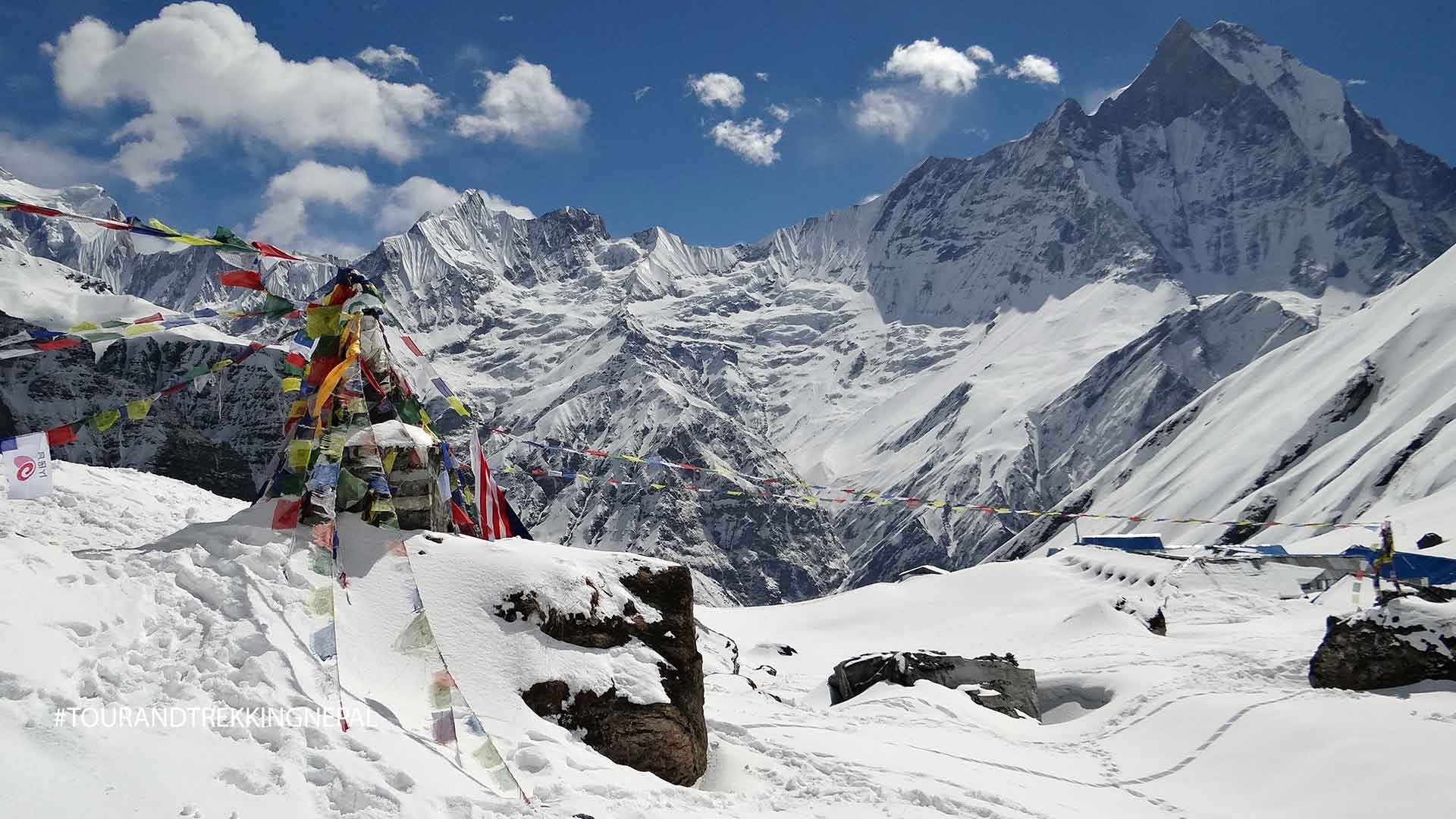
  • The closest glimpse of the 10th highest mountain in the world Annapurna I, along with (Annapurna II, Annapurna III, Annapurna IV, Annapurna V, Annapurna South, Gangapurna.
  • The diverse faces of the most iconic mountain in Annapurna rage – Mt. Machhapuchhre.
  • The view of giant Annapurna South, Glacier of Annapurna and Annapurna Base Camp, and 360-degree mountain view.
  • Natural hot spring in Jhinu Danda.

The Annapurna Base Camp Private Trek is a personal and customized excursion. It takes you to Annapurna Sanctuary, one of Nepal’s most well-known trekking locations. In contrast to standard group treks, a private trek provides a more personalized and personal experience. An overview of what to anticipate from an exclusive journey to Annapurna Base Camp is provided below:

Personal Trip: You can alter the schedule for a personalized journey to suit your interests. Both the duration of the journey and its pace are up to you. Even so, you are free to take diversions to explore specific locations of interest.

Specialized Guide and Porter: Private trek packages usually include a professional local guide and a porter to help carry your belongings. A guide guarantees your safety, and porters reduce the physical strain of the journey.

Customizable Time Line: You can begin your adventure whenever convenient. There’s no set date of departure, and it’s convenient. This is your chance to steer clear of busy times. Accommodations: You can choose the lodging that best suits your needs. Lodges range from standard teahouses to luxurious lodges. You may choose based on your interests or even go camping in specific areas. This gives your walk an extra layer of comfort.

Special Attention: Your guide can concentrate on your preferences and activities. Your guidance will be entirely focused on you. You can pick up the wildlife’s local lifestyle information or take picture-perfect shots.

Acclimatization: Resting or allowing your body to acclimate is essential. It is critical to adapt to the environment and prevent altitude sickness. Acclimatization days can be part of your personalized expedition. This aids in your safe ascent to higher elevations.

Different Experience: You and your guide can embark on this Annapurna base camp private trip, a solo trek. There are fewer people around, which makes it more peaceful. You may, therefore, have a unique experience in the breathtaking Annapurna Base Camp Private Trek.

annapurna base camp trek 10 best reasons to choose annapurna base camp trek

Annapurna Base Camp Private Trek is one of the most popular and renowned trekking trails in the Himalayas of Nepal. This classical trek has a lot of good tea houses in high altitudes and very nice hotels and guest houses in lower altitudes. Annapurna Base Camp Private Trek rooms are cheaper if you eat your meals in the same hotel. Normally Ghandruk, Ghorepani, Chomrong and Jhinu Danda have nice rooms with attached bathrooms and mountain views. Afterwards, the living places would be on a normal, sharing basis but every teahouse will offer the best hospitality as much as possible.

The bed has a good mattress, a clean bed sheet, one warm blanket, and a comfortable pillow in a cosy room. Also, the more you ascend up towards the base camp, the number of tea houses will be less and will be occupied during the prime trekking season.

Deciding how many days to spend in Nepal depends on various factors, including your interests, the areas you want to explore, and the activities you plan to engage in. Nepal is a diverse country with a rich cultural heritage, stunning natural landscapes, and a plethora of adventure opportunities.

To experience these natural attractions, a one-week trip will enable you to go on a short trek, or river trip, or visit some small towns near Kathmandu. Two weeks will allow for a longer trek, a trip to a national park for wildlife spotting, or a mixed cultural and nature tour.

To experience the best of Nepal, plan for three to four weeks; this is enough time to complete a serious trek, such as the remote and under-visited Makalu Base Camp or Arun Valley to Everest Base Camp Trek, and have some extra time left to experience culture, jungle and other adventure activities such as rafting.

To explore Nepal’s natural wonders, the duration of your trip will dictate the depth of your experiences. For a one-week excursion, you can opt for a short trek, river trip, or visit small towns near Kathmandu. Extending your stay to two weeks allows for a more extensive trek, wildlife spotting in a national park, or a blend of cultural and nature tours.

For an immersive Nepal experience spanning three to four weeks, you can embark on a serious trek like the Makalu Base Camp or Arun Valley to Everest Base Camp trek, leaving ample time for cultural exploration, jungle adventures, and activities such as rafting.

Here are suggested itineraries ranging from three days to over four weeks:

Nepal in 3 days: Spend three days exploring the historical, architectural, and religious treasures of Kathmandu, including Kathmandu and Patan Durbar Squares, Swayambhunath Stupa, Pashupatinath Temple, and Boudhanath Stupa.

Nepal in 5-7 days: Extend your visit to scenic Pokhara, enjoying activities like paragliding, boating, and trekking. Alternatively, experience wildlife in Chitwan National Park or explore the lesser-visited Barauli village.

Nepal in 10 days: Combine Kathmandu and Pokhara highlights with a trek near Kathmandu or Pokhara, such as the Khopra Danda trek or the Langtang Valley Trek. Add white-water rafting or kayak lessons for an adventurous touch.

Nepal in 2 weeks: Explore Chitwan National Park or Bardia National Park for wildlife spotting. Consider adding white-water rafting or kayaking to your itinerary. If interested in trekking, venture into the Everest region for a sample trek or explore more remote options like Nar Phu Valley or Dhorpatan.

Nepal in 3 weeks: Combine cultural activities with a mid-length trek, exploring regions like Langtang Valley, Tamang Heritage Trail, or Gosainkunda. For a more remote experience, consider Upper Mustang or Upper Dolpo.

Nepal in more than 4 weeks: With four weeks, delve into wilderness areas with treks like the Arun Valley to Everest Base Camp or Makalu Base Camp trek. Challenge yourself with trekking peaks like Mera Peak, providing a different dimension to your Nepal adventure. Allow time for relaxation in Kathmandu or Pokhara.

Allowing for rest days in Kathmandu or Pokhara, four weeks provide ample time to delve into the wilderness, undertake challenging treks, and experience Nepal’s diverse landscapes and cultures.

Teahouse trekking in Nepal offers a unique blend of stunning landscapes, cultural immersion, and comfortable accommodations, making it an ideal adventure for both novice and seasoned trekkers. Nestled in the heart of the Himalayas, the Teahouse trekking in Nepal trekking experience allows you to traverse through picturesque trails while relishing the warmth of traditional teahouses along the way.

Most treks in Nepal are ‘teahouse’ treks, which means every night you end up at a simple lodge with basic rooms and a meal. The best thing about teahouse trekking – you only have to carry very minimal gear. Teahouse trekking in Nepal refers to staying in a lodge for each night of your trek. Almost all of the main trekking routes in Nepal are teahouse treks, and allow the trekker to travel with the minimum amount of gear.

What is a teahouse trekking in Nepal?

Teahouse trekking in Nepal varies slightly from region to region, but most are simple stone and wooden buildings or huts that have a kitchen, a communal eating hall and bathroom area, and a number of basic bedrooms that usually have two single beds and a table. Most teahouses are built specifically for trekkers, but some, in the more remote regions of Nepal, may double as the family’s home.

Expect the rooms to be basic but clean, and to pay slightly more for an attached bathroom. Your room will come with a thick blanket (feel free to double up if it is cold), which you can use as a second layer over top of your sleeping bag or as your main blanket for the night. Most trekkers skip showers during their trek, but some teahouses do offer hot bucket showers at a small fee.

Insider tip: If you are worried about cleanliness, bring your own bed linen or light sleeping bag from home or purchase one in Kathmandu or Pokhara. It’s always wise to bring a pair of earplugs, as the walls in most teahouses are quite thin.)

The allure of teahouse trekking lies in the opportunity to connect with the local communities and witness their way of life up close. The trekking trails wind through lush forests, terraced fields, and quaint mountain villages, providing a diverse and ever-changing backdrop. Trekkers can savour the stunning vistas of snow-capped peaks, including iconic giants like Annapurna and Everest while relishing the warm hospitality of the teahouse hosts.

Teahouses typically offer simple yet comfortable accommodations, often with shared dining areas where trekkers can mingle and share stories. The local cuisine, featuring hearty Dal Bhat (lentil soup with rice) and momos (dumplings), provides sustenance for the challenging trekking days. This communal atmosphere fosters a sense of camaraderie among trekkers from around the world, creating lasting memories and friendships.

The well-established teahouse infrastructure along popular trekking routes such as the Annapurna and Everest Base Camp adds to the convenience of this trekking style. Trekkers can focus on enjoying the journey without the burden of carrying camping equipment, as teahouses provide comfortable beds, warm meals, and a chance to recharge for the next day’s adventure.

tea house trekking in the himalayas

Teahouse trekking in Nepal also contributes to the local economy, as the income generated by these establishments directly benefits the surrounding communities. Teahouse trekking in Nepal is a sustainable and responsible approach to trekking that allows visitors to experience the beauty of Nepal while supporting the livelihoods of the people who call these remote mountain areas home.

Teahouse trekking in Nepal is a harmonious blend of adventure, culture, and community. It offers a unique opportunity to explore the Himalayas while forging connections with the local people, making it an unforgettable and enriching experience for trekkers seeking both natural beauty and cultural immersion.

Getting your visa for Nepal is a crucial step in ensuring a smooth and enjoyable visit to this beautiful Himalayan nation. Whether you’re planning a trekking to Everest Base Camp, Annapurna Base Camp, Langtang Valley, Annapurna Circuit etc, exploring the vibrant culture of Kathmandu, jungle safari in Chitwan National Park, or seeking spiritual solace in Lumbini, obtaining the right visa is essential.

Nepal is a beautiful country of the Himalayas, and every year, thousands of tourists influx here to observe cultural, geographical, and traditional diversities. Unfortunately, many people are unaware of the visa process in Nepal.

Nepal offers various types of visas, including tourist visas, business visas, and residential visas. For most travellers, a tourist visa is the relevant option. Here is a step-by-step guide to help you navigate the visa application process:

Getting Your Visa for Nepal at a Nepali Embassy:

Prior to departing your home country, you can apply for a Nepali visa at the local Nepali Embassy or by mailing your application to them well in advance.

Most travellers can get a Nepali visa on arrival:

For most travellers, the entry requirements for Nepal are fairly simple and pain-free. Indian citizens do not need a tourist visa to visit the country, and most other tourists can get a 15-, 30- or 90-day visa on arrival. This includes visitors from the United States, Canada, Australia, New Zealand, Japan, South Korea, the UK, Ireland, France, Germany and most other Western European countries.

When you land at Kathmandu’s Tribhuvan International Airport, you need to fill in an arrival card and have your photo taken at one of the automatic registration machines – to save time, you can do this online in advance (this must be done less than 15 days before you arrive). If you leave it till you land in Kathmandu, expect the process to take over an hour, with lots of queuing.

Getting Your Visa for Nepal at a Land Border Crossing:

There are also Immigration Offices at all of the land border crossings that are open to foreigners. You’ll be able to apply for and receive a visa at these border crossings, as well.

Getting Your Visa for Nepal Price and Duration:

There are three options for the length of a tourist visa (for nationals of SAARC countries, the first 30 days are free):

Duration of Stay Price
15 days $30 USD
30 days $50 USD
90 days $125 USD
Multiple-entry $25 USD (Useful for going back and forth between Tibet and India)

Extending Your Visa:

After getting your visa for Nepal, you can extend your Nepal visa for up to 150 days at the Immigration Department in Kathmandu or Pokhara. It costs $30 for 15 days and $2 per day after that. Usually, the turn-around is the same day, and you’ll need to submit your passport, extension fee, one photo, and the application extension form to complete the process.

Getting Your Visa for Nepal Additional Expert Tips:

  • It is a good idea to bring 4-5 passport photos from home as they come in handy for official documents or purchasing sim cards.
  • Kathmandu’s airport has bank counters where you can exchange currencies.
  • Having a couple of photocopies of your passport is always handy while travelling.
  • While there are various payment methods now available in the airport along with the visa application kiosks, malfunctions can occur and we strongly recommend that you carry the correct money (US$ is recommended) and a passport photo with you just in case.

family tour in nepal charity tour and trekking experience in Nepal

Getting Your Visa for Nepal is a crucial step in planning your visit. By following the proper procedures, preparing the required documents, and staying informed about the latest regulations, you can ensure a smooth and enjoyable experience in this enchanting Himalayan nation.

Experience the Annapurna Base Camp is a sentence that invites you to have an adventure in one of the most beautiful trekking destinations in the world, located in the Annapurna region of Nepal. Annapurna Base Camp Trek is an unparalleled journey that intertwines breathtaking landscapes, cultural richness, and a profound sense of accomplishment. As you ascend through the lush rhododendron forests and quaint mountain villages, each step reveals the majestic grandeur of the Annapurna range.

Experience the Annapurna Base Camp Trek commences in Nayapul, and with every passing day, the scenery evolves, offering a kaleidoscope of terraced fields, cascading waterfalls, and snow-capped peaks. The charming hospitality of local Gurung and Magar communities adds a cultural tapestry to the adventure. Teahouse stays provide authentic insight into the Himalayan way of life, allowing trekkers to forge connections with the warm-hearted locals.

Experience the Annapurna Base Camp Highlights:

  • Marvel at the stunning landscapes of the Annapurna Region, with panoramic views of snow-capped peaks, lush green valleys, and traditional Nepalese villages.
  • Trek to the iconic Annapurna Base Camp, surrounded by towering Himalayan peaks. The journey offers a sense of accomplishment for the whole family.
  • Experience the awe-inspiring sunrise from Poon Hill, offering one of the best panoramic views of the Annapurna and Dhaulagiri mountain ranges.
  • The Annapurna Region offers well-established trekking trails suitable for families, with gradual ascents and descents, making it accessible for children and older family members.
  • Discover the charm of Ghorepani, a picturesque village with traditional architecture, friendly locals, and vibrant markets, providing a cultural and scenic respite.
  • Explore the rich biodiversity of the region, including rhododendron forests, diverse wildlife, and a variety of bird species, making the trek a unique and educational experience.
  • Immerse yourselves in the local culture by visiting traditional villages along the trekking route. Witness daily life, interact with locals, and learn about their unique customs and traditions.
  • Relax in natural hot springs at Jhinu Danda, providing a rejuvenating break for tired muscles and a memorable experience for the entire family.

Sunrise at Annapurna Base Camp is a spiritual experience. The first rays of sunlight gradually illuminate the peaks, casting a warm glow that transforms the icy giants into a radiant spectacle. This ethereal moment, shared with fellow trekkers from around the globe, fosters a sense of camaraderie and unity in the face of nature’s grandeur.

The journey down retraces the steps, allowing time for reflection and appreciation of the challenges overcome. The hot springs of Jhinu Danda provide a therapeutic respite for tired muscles, offering a moment of relaxation amid the rugged terrain.

The month of October marks the start of the autumn season. The monsoon season is over. The region’s most recent rainfall cleansed the air of dust, allowing the Annapurna range to be seen more clearly. The beautiful sunny Himalayas with snow-capped peaks can be seen from a distance.

Green hills with gorgeous skies provide the best sense of nature. The views of the mountains are spectacular because there is no dust in the air. The area becomes pollution-free, which is good for people’s health. The breathtaking views from the highest points make you proud of your decision to visit.

Experience the Annapurna Base Camp Trek offers you wonderful and jaw-dropping views of several Himalayan mountains like Annapurna Range (8,091 m), Mt. Dhaulagiri (8,167 m), Mt. Machhapuchhare (6,993 m), Mt. Nilgiri (7,061 m), Mt. Hiunchuli (6,441 m), Mt. Gangapurna (7,455 m), Tukuche Peak 96,920 m), Varaha Shikhar (7,847 m), etc.

Experience the Annapurna Base Camp Trek is more than a physical journey; it is a soul-stirring odyssey that immerses you in the raw beauty of the Himalayas. The memories forged along the trail, the camaraderie with fellow trekkers, and the sheer majesty of the mountains make it an experience that lingers in your heart, inviting you to return to the embrace of the Annapurna sanctuary again and again.

Tour and Trekking Nepal ensures that you will have a pleasant tour or trekking experience with us from the moment you arrive in Nepal. Enjoy this magnificent experience with the assurance that our trained, professional Tour and Trekking Nepal team will be there to assist you at every turn. We will even help you put together your very own custom vacation package.

Certifications and Affiliations

npl

Registered with: Company Registration Office, Government of Nepal

ntb

Licensed by: Department of Tourism and Nepal Tourism Board

taan

Proud Member of Trekking Agency's Association of Nepal

nma

General Member of Nepal Mountaineering Association