Annapurna Circuit Trek is one of the most loved treks in the world but how long is the Annapurna Circuit Trek? Annapurna Circuit Trek is famous for its geographical diversity that ranges from lush green forests to barren, desert-like landscapes. The cultural exploration of the Tibetan Buddhist-influenced settlements of the Gurung, Thakali, and Magar communities is the prime attraction of the trek.

The Annapurna Circuit Trek allows trekkers to witness the diverse ethnic communities of the region, including Gurungs, Thakalis, and Manangis, each with its unique culture and traditions. The trail passes through the Annapurna Conservation Area, showcasing a variety of flora and fauna, contributing to its designation as a biodiversity hotspot.

Annapurna Circuit Trek Highlights:

  • Scenic drive from Kathmandu to Bhulbhule
  • Visit Manang village and enjoy stunning views of Gangapurna Glacier
  • Cross the challenging Thorong La Pass (5,416 m)
  • Get blessed at Muktinath Temple, one of the holiest temples of Hindus
  • Trek through Kali Gandaki Valley and Kali Gandaki Gorge, the deepest gorge in the world
  • Taste delicious apples at Marpha, the capital of apples
  • Soak your body in the natural hot spring at Tatopani
  • Experience the rich culture of different ethnic groups
  • Trek through beautiful Rhododendron, birch, juniper & oak forests
  • Witness the stunning sunrise view from Poon Hill
  • Explore the city of Lakes, Pokhara

The trails pass through the Marshyangdi Valley and the meadows of Yak Kharka to finally arrive at the majestic Thorung La Pass. The Thorung La Pass is the highest point of the trek situated at an altitude of 5,416m. From Thorung-La pass, we arrive at the settlements of Mustang in the upper Kali Gandaki Valley.

We also pay for our pilgrimage to the sacred temple of Muktinath. Muktinath temple is highly revered by both Buddhists and the Hindu community. The temple features holy 108 showers and according to popular beliefs, bathing in them cleanses the sins committed in the mortal life.

We then pass through the settlements of Marpha and Tatopani to arrive at the viewpoint of Poonhill. From the Poonhill viewpoint, we observe the spectacular sunrise and then drive back to Pokhara. Besides that, we are also blessed with majestic views of the entire Annapurna Massif from various points of the trek.

Annapurna Circuit Trek provides a perfect blend of natural beauty and cultural immersion, making it a favourite among adventure enthusiasts from around the world. The diverse terrain, challenging ascents, and the warm hospitality of the local communities contribute to its reputation as one of the most rewarding treks in the Himalayas. Whether you seek an adrenaline-pumping adventure or a soul-enriching cultural experience, the Annapurna Circuit Trek offers an unforgettable journey through the heart of Nepal’s majestic mountains.

Flying to the top of the Everest is not just a physical triumph but a testament to the indomitable spirit of human ambition. Standing on that sacred peak, I felt a profound connection to the earth below and the limitless sky above, a soaring testament to the human spirit’s ability to conquer even the loftiest of dreams.

Kathmandu Summit Adventure offers thrilling flying to the top of the Everest experience, combining the breathtaking landscapes of the Himalayas with the rich cultural tapestry of the region. One of the most extraordinary adventures that beckon travellers is the opportunity to soar to the top of the world, standing atop the iconic Mount Everest. A helicopter tour in Nepal provides a unique and unforgettable perspective on the majestic peaks, allowing enthusiasts to witness the awe-inspiring beauty of the Himalayas.

Flying to the Top of the Everest Highlights:

Convenience and accessibility:

Reaching Everest Base Camp on foot may be a long and challenging journey that takes several weeks, and summiting the peak requires months of preparation. The Everest Base Camp Helicopter Tour, on the other hand, provides an efficient and convenient option. It enables explorers to see the spectacular scenery of the Everest region without the physical difficulties of a complete climbing excursion.

Aerial Adventure Like No Other:

As your chopper takes off, you are suddenly transported to a world of adventure that few have ever known. The unexpected journey from the lush valleys below to the white realm above is an explosion of emotions. The smooth hum of the rotor blades adds rhythm to your happiness, and the Himalayas spread out before you like a living tapestry of giants as you gaze out the window. Stories of bravery, triumph, and the unbreakable human spirit are carved into the rocky faces of these mountains.

A Date with Destiny in Kala Patthar:

The Everest Base Camp Helicopter Tour has a surprise in store for you: a visit to the iconic viewpoint point of Kala Patthar. It’s a mountain in its own right, at 5,545 meters (18,192 feet), with a heart-pounding vista of Everest’s summit. You’ll get your first look at the world’s tallest mountain when your chopper flies above. It stands bold and majestic, a challenge to those who dare to dream. Your heart skips a beat when you realize you’re getting closer to the summit than you ever imagined.

The Dangerous Dance:

As you soar up above, you can not help but admire the creative abilities of human engineering. Helicopters are technological marvels built to withstand extreme circumstances. The Himalayas are no different. You’ll get a firsthand look at your pilot’s talent as they navigate through tiny valleys and rise above dangerous terrain. It’s a thrilling dance with dangers, an indicator that adventure is imprinted into the very fibre of our DNA.

A Peek into the Unknown:

The opportunity to explore the unknown is one of the most fascinating aspects of this voyage. While hikers take well-trodden pathways, your helicopter is your passport to the Himalayas’ unspoiled regions. You’ll come across isolated valleys, gorgeous lakes, and distant communities that few have seen. It’s a monument to the power of discovery and an uncovering of the pristine beauty of the Everest region.

Time Dilation:

On this voyage, time is a strange thing. Traditional trekkers spend weeks acclimatizing and climbing to Everest Base Camp, but you’ll be there in a few hours. This one-of-a-kind benefit frees up your itinerary, allowing you to see more of Nepal or begin on new adventures sooner. It is a time-bending experience in which every second counts.

Safety in the Skies:

The Everest region is recognized for its unpredictability and harsh weather conditions. Mountaineers and trekkers rely on helicopters to ensure their safety. They act as a lifeline, taking those in danger to safety. It’s reassuring to know that rescue is only a rotor spin away in these difficult terrains.

A Luxury and Thrills Journey:

The Everest Base Camp Helicopter Tour perfectly blends luxury and adventure. You’re not just an adventurer as you fly over the clouds; you’re royalty in the skies. Experienced guides and pilots attend to your every need, ensuring that your journey is as relaxing as it is thrilling. It is the pinnacle of luxury experience, a sensory thrill from takeoff to touchdown.

Enriching Lives by Sup:

Flying to the top of the Everest journey typically begins in Kathmandu, the bustling capital of Nepal, where adventurers board a helicopter that will navigate the challenging terrain to reach Everest Base Camp. As the helicopter ascends, the landscape transforms from lush valleys to rugged mountain terrain, offering panoramic views of the world’s highest peaks, including Ama Dablam, Lhotse, and Nuptse.

A helicopter tour to the Everest Base Camp encapsulates the spirit of adventure and the allure of the Himalayas. It is an experience that transcends the ordinary, allowing you to witness the grandeur of Everest from a vantage point reserved for the most intrepid explorers. Nepal, with its rich cultural tapestry and unparalleled natural beauty, awaits those who seek to elevate their travel experiences to new heights.

Nepal trekking permit goes digital aligns with its commitment to enhancing the overall experience for adventure enthusiasts while ensuring the conservation of its natural treasures. The government aims to leverage technology to promote tourism responsibly and sustainably, fostering a balance between the economic benefits of tourism and the preservation of the pristine landscapes that attract visitors from around the globe.

After over seven decades since Nepal started issuing trekking permits to foreigners, the government has finally ended the paper-based permit issuing system. This comes weeks after the Nepali visa application system went online.

The Department of Immigration started the online system for trekkers on February 23.

Foreign trekkers are no longer required to be present at the immigration office to obtain permits to hike in restricted areas, said Prem Prasad Dhakal, spokesperson at the department.

“The online application system will save time. Trekkers will no longer be required to stand in queues at banks to pay the fees.” However, the payment should be made only through Nepali payment channels including Nepali mobile banking apps, and payment platforms like Connect IPS, E-sewa and Khalti.

According to Dhakal, as the Nepal government doesn’t have a dollar account, currently, it is not possible for foreigners to pay the fee in US dollars or other foreign currencies, to get trekking permits.
Trekking permits for unrestricted areas or the Trekkers’ Information Management System (TIMS), which are issued jointly by the Nepal Tourism Board and the Trekking Agencies Association of Nepal, which came into effect on January 1, 2008 went online on April 1 last year.

Apart from dozens of unrestricted trekking areas, there are certain trekking regions known as ‘restricted areas’ that are highly regulated by the government where free independent trekkers are strictly forbidden.

Taplejung, Sankhuwasabha, Solukhumbu, Dolakha, Rasuwa, Gorkha, upper Mustang, Manang, upper Dolpa, lower Dolpa, Mugu, Humla, Bajhang, and Darchula districts that border Tibet were declared out of bounds for foreign visitors in the 1970s.

Foreigners are required to obtain special permits from the Department of Immigration to travel to these areas. Also, permits are not given to individual trekkers. Only those travelling in a group through a government-authorised trekking agency can apply for such permits.

Permit fees range from $10 a week to $500 for 10 days, depending on the area.

In the 1970s, the government imposed restrictions on the movement of foreigners in several northern villages bordering Tibet as Khampa rebels were found to be using the Nepali territory to mount raids into China. In 1974, the Nepal Army succeeded in completely disarming the Khampa rebels, but the travel restrictions remained.

The official history of trekking in Nepal started in 1949 when the country opened its doors to the outside world after centuries of isolation.

British diplomat and mountaineer Lieutenant Colonel James Owen Merion Roberts is credited with organising the first commercial trek in Nepal in 1950. Trekking agencies and tour operators have been lobbying with the government to open up such areas that have an immense potential to contribute to the country’s tourism as well as the local economy.

Trekking in some restricted areas is costlier.
In the restricted Gorkha-Manaslu area, and Manang and Mugu, in autumn (September-November), foreign trekkers have to pay $100 per person per week and $15 per person per day beyond a week. In the December-August period, which is considered off-season for trekking, it costs $75 a person per week and $10 a person per day beyond a week.

In Bajhang and Darchula, the government charges $90 per person per week for the first week and $15 per person per day beyond a week. In the restricted areas in Humla, trekkers are charged $50 per person per week and $10 per person per day beyond a week.

Trekkers visiting restricted areas of Gorkha Tsum Valley are charged $40 per person per week and $7 per person per day beyond a week during the autumn season. For the period December-August, the fee is $30 per person per week and $7 per person per day beyond a week.

Likewise, restricted areas in Taplejung, lower Dolpa, Dolakha, Sankhuwasabha, Solukhumbu and Rasuwa are charged $20 per person per week. In 2022, according to government statistics, the restricted areas received 15,781 foreign trekkers, mostly in Manaslu and upper Mustang.

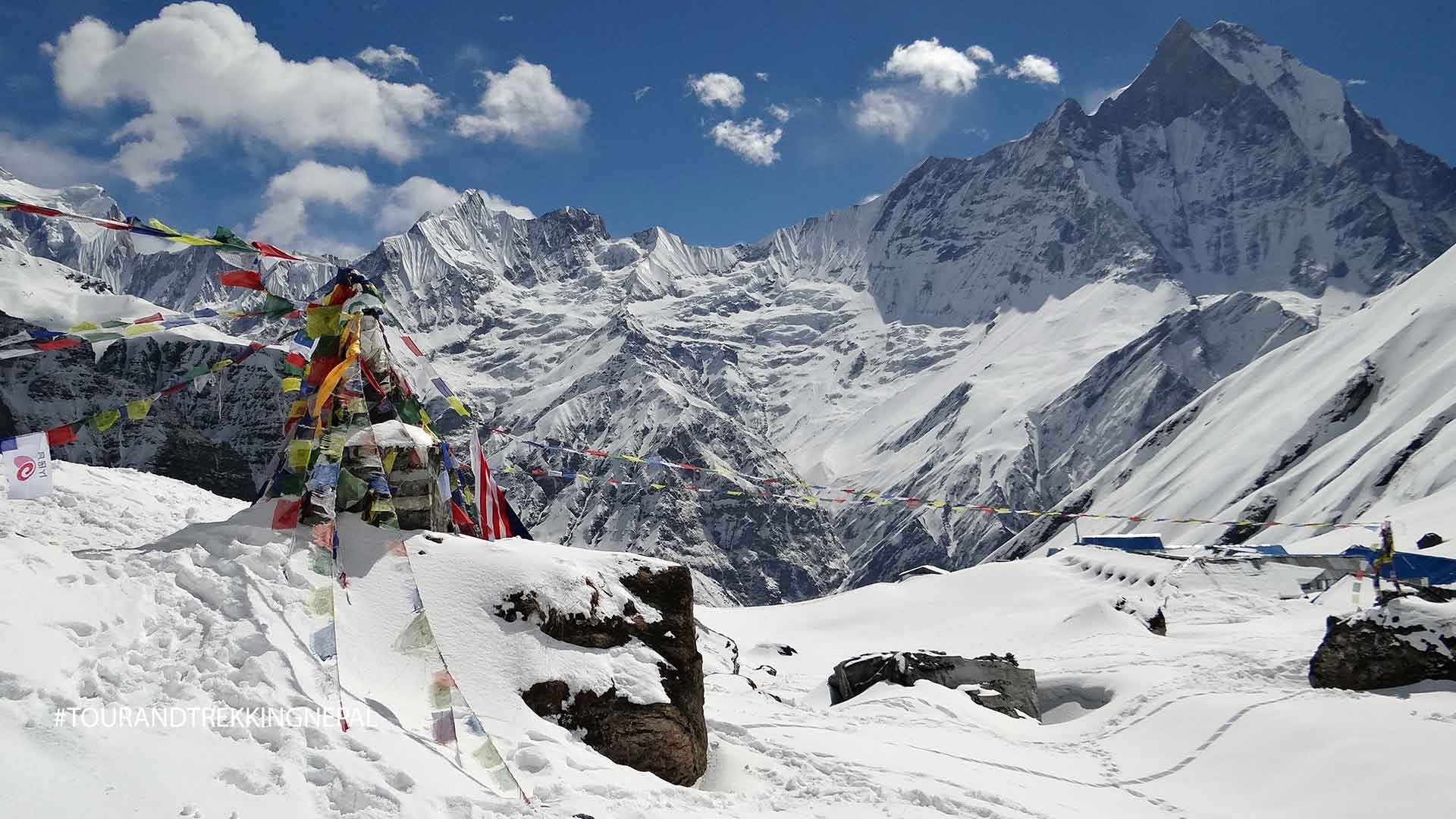
Annapurna Base Camp Private Trek is a world-famous trek that takes you to the foothills of the world’s 10th-highest mountain, Mt. Annapurna (8,091 m). Annapurna Base Camp Private Trek is an unforgettable adventure that begins from a lush lowland and takes you through the tempting Annapurna Himalayas. With professional guidance and support from Tour and Trekking Nepal, you can expect to have a smooth and memorable trekking experience of a lifetime.

Annapurna Base Camp Private Trek Highlights:

  • Historic Ghandruk village, Gurung community, their culture, traditions, and practices.
  • A pleasant and vibrant walk through the bank of Modi Khola, crossing dense alpine forests inside the Annapurna Conservation Area.
  • Gorgeous sunrise from Poon Hill viewpoint over the snow-capped peaks of Mt. Dhaulagiri, Annapurna Ranges, Nilgiri, and many more.
  • Experience the exotic flora and fauna in the renowned Annapurna Conservation Area.
  • The amazing trail passes through many beautiful villages, waterfalls, rainforests, and alpine biodiversity.
  • The walk between Machhapuchhre Base Camp and Annapurna Base Camp.
  • The closest glimpse of the 10th highest mountain in the world Annapurna I, along with (Annapurna II, Annapurna III, Annapurna IV, Annapurna V, Annapurna South, Gangapurna.
  • The diverse faces of the most iconic mountain in Annapurna rage – Mt. Machhapuchhre.
  • The view of giant Annapurna South, Glacier of Annapurna and Annapurna Base Camp, and 360-degree mountain view.
  • Natural hot spring in Jhinu Danda.

The Annapurna Base Camp Private Trek is a personal and customized excursion. It takes you to Annapurna Sanctuary, one of Nepal’s most well-known trekking locations. In contrast to standard group treks, a private trek provides a more personalized and personal experience. An overview of what to anticipate from an exclusive journey to Annapurna Base Camp is provided below:

Personal Trip: You can alter the schedule for a personalized journey to suit your interests. Both the duration of the journey and its pace are up to you. Even so, you are free to take diversions to explore specific locations of interest.

Specialized Guide and Porter: Private trek packages usually include a professional local guide and a porter to help carry your belongings. A guide guarantees your safety, and porters reduce the physical strain of the journey.

Customizable Time Line: You can begin your adventure whenever convenient. There’s no set date of departure, and it’s convenient. This is your chance to steer clear of busy times. Accommodations: You can choose the lodging that best suits your needs. Lodges range from standard teahouses to luxurious lodges. You may choose based on your interests or even go camping in specific areas. This gives your walk an extra layer of comfort.

Special Attention: Your guide can concentrate on your preferences and activities. Your guidance will be entirely focused on you. You can pick up the wildlife’s local lifestyle information or take picture-perfect shots.

Acclimatization: Resting or allowing your body to acclimate is essential. It is critical to adapt to the environment and prevent altitude sickness. Acclimatization days can be part of your personalized expedition. This aids in your safe ascent to higher elevations.

Different Experience: You and your guide can embark on this Annapurna base camp private trip, a solo trek. There are fewer people around, which makes it more peaceful. You may, therefore, have a unique experience in the breathtaking Annapurna Base Camp Private Trek.

annapurna base camp trek 10 best reasons to choose annapurna base camp trek

Annapurna Base Camp Private Trek is one of the most popular and renowned trekking trails in the Himalayas of Nepal. This classical trek has a lot of good tea houses in high altitudes and very nice hotels and guest houses in lower altitudes. Annapurna Base Camp Private Trek rooms are cheaper if you eat your meals in the same hotel. Normally Ghandruk, Ghorepani, Chomrong and Jhinu Danda have nice rooms with attached bathrooms and mountain views. Afterwards, the living places would be on a normal, sharing basis but every teahouse will offer the best hospitality as much as possible.

The bed has a good mattress, a clean bed sheet, one warm blanket, and a comfortable pillow in a cosy room. Also, the more you ascend up towards the base camp, the number of tea houses will be less and will be occupied during the prime trekking season.

Deciding how many days to spend in Nepal depends on various factors, including your interests, the areas you want to explore, and the activities you plan to engage in. Nepal is a diverse country with a rich cultural heritage, stunning natural landscapes, and a plethora of adventure opportunities.

To experience these natural attractions, a one-week trip will enable you to go on a short trek, or river trip, or visit some small towns near Kathmandu. Two weeks will allow for a longer trek, a trip to a national park for wildlife spotting, or a mixed cultural and nature tour.

To experience the best of Nepal, plan for three to four weeks; this is enough time to complete a serious trek, such as the remote and under-visited Makalu Base Camp or Arun Valley to Everest Base Camp Trek, and have some extra time left to experience culture, jungle and other adventure activities such as rafting.

To explore Nepal’s natural wonders, the duration of your trip will dictate the depth of your experiences. For a one-week excursion, you can opt for a short trek, river trip, or visit small towns near Kathmandu. Extending your stay to two weeks allows for a more extensive trek, wildlife spotting in a national park, or a blend of cultural and nature tours.

For an immersive Nepal experience spanning three to four weeks, you can embark on a serious trek like the Makalu Base Camp or Arun Valley to Everest Base Camp trek, leaving ample time for cultural exploration, jungle adventures, and activities such as rafting.

Here are suggested itineraries ranging from three days to over four weeks:

Nepal in 3 days: Spend three days exploring the historical, architectural, and religious treasures of Kathmandu, including Kathmandu and Patan Durbar Squares, Swayambhunath Stupa, Pashupatinath Temple, and Boudhanath Stupa.

Nepal in 5-7 days: Extend your visit to scenic Pokhara, enjoying activities like paragliding, boating, and trekking. Alternatively, experience wildlife in Chitwan National Park or explore the lesser-visited Barauli village.

Nepal in 10 days: Combine Kathmandu and Pokhara highlights with a trek near Kathmandu or Pokhara, such as the Khopra Danda trek or the Langtang Valley Trek. Add white-water rafting or kayak lessons for an adventurous touch.

Nepal in 2 weeks: Explore Chitwan National Park or Bardia National Park for wildlife spotting. Consider adding white-water rafting or kayaking to your itinerary. If interested in trekking, venture into the Everest region for a sample trek or explore more remote options like Nar Phu Valley or Dhorpatan.

Nepal in 3 weeks: Combine cultural activities with a mid-length trek, exploring regions like Langtang Valley, Tamang Heritage Trail, or Gosainkunda. For a more remote experience, consider Upper Mustang or Upper Dolpo.

Nepal in more than 4 weeks: With four weeks, delve into wilderness areas with treks like the Arun Valley to Everest Base Camp or Makalu Base Camp trek. Challenge yourself with trekking peaks like Mera Peak, providing a different dimension to your Nepal adventure. Allow time for relaxation in Kathmandu or Pokhara.

Allowing for rest days in Kathmandu or Pokhara, four weeks provide ample time to delve into the wilderness, undertake challenging treks, and experience Nepal’s diverse landscapes and cultures.

Teahouse trekking in Nepal offers a unique blend of stunning landscapes, cultural immersion, and comfortable accommodations, making it an ideal adventure for both novice and seasoned trekkers. Nestled in the heart of the Himalayas, the Teahouse trekking in Nepal trekking experience allows you to traverse through picturesque trails while relishing the warmth of traditional teahouses along the way.

Most treks in Nepal are ‘teahouse’ treks, which means every night you end up at a simple lodge with basic rooms and a meal. The best thing about teahouse trekking – you only have to carry very minimal gear. Teahouse trekking in Nepal refers to staying in a lodge for each night of your trek. Almost all of the main trekking routes in Nepal are teahouse treks, and allow the trekker to travel with the minimum amount of gear.

What is a teahouse trekking in Nepal?

Teahouse trekking in Nepal varies slightly from region to region, but most are simple stone and wooden buildings or huts that have a kitchen, a communal eating hall and bathroom area, and a number of basic bedrooms that usually have two single beds and a table. Most teahouses are built specifically for trekkers, but some, in the more remote regions of Nepal, may double as the family’s home.

Expect the rooms to be basic but clean, and to pay slightly more for an attached bathroom. Your room will come with a thick blanket (feel free to double up if it is cold), which you can use as a second layer over top of your sleeping bag or as your main blanket for the night. Most trekkers skip showers during their trek, but some teahouses do offer hot bucket showers at a small fee.

Insider tip: If you are worried about cleanliness, bring your own bed linen or light sleeping bag from home or purchase one in Kathmandu or Pokhara. It’s always wise to bring a pair of earplugs, as the walls in most teahouses are quite thin.)

The allure of teahouse trekking lies in the opportunity to connect with the local communities and witness their way of life up close. The trekking trails wind through lush forests, terraced fields, and quaint mountain villages, providing a diverse and ever-changing backdrop. Trekkers can savour the stunning vistas of snow-capped peaks, including iconic giants like Annapurna and Everest while relishing the warm hospitality of the teahouse hosts.

Teahouses typically offer simple yet comfortable accommodations, often with shared dining areas where trekkers can mingle and share stories. The local cuisine, featuring hearty Dal Bhat (lentil soup with rice) and momos (dumplings), provides sustenance for the challenging trekking days. This communal atmosphere fosters a sense of camaraderie among trekkers from around the world, creating lasting memories and friendships.

The well-established teahouse infrastructure along popular trekking routes such as the Annapurna and Everest Base Camp adds to the convenience of this trekking style. Trekkers can focus on enjoying the journey without the burden of carrying camping equipment, as teahouses provide comfortable beds, warm meals, and a chance to recharge for the next day’s adventure.

tea house trekking in the himalayas

Teahouse trekking in Nepal also contributes to the local economy, as the income generated by these establishments directly benefits the surrounding communities. Teahouse trekking in Nepal is a sustainable and responsible approach to trekking that allows visitors to experience the beauty of Nepal while supporting the livelihoods of the people who call these remote mountain areas home.

Teahouse trekking in Nepal is a harmonious blend of adventure, culture, and community. It offers a unique opportunity to explore the Himalayas while forging connections with the local people, making it an unforgettable and enriching experience for trekkers seeking both natural beauty and cultural immersion.

Getting your visa for Nepal is a crucial step in ensuring a smooth and enjoyable visit to this beautiful Himalayan nation. Whether you’re planning a trekking to Everest Base Camp, Annapurna Base Camp, Langtang Valley, Annapurna Circuit etc, exploring the vibrant culture of Kathmandu, jungle safari in Chitwan National Park, or seeking spiritual solace in Lumbini, obtaining the right visa is essential.

Nepal is a beautiful country of the Himalayas, and every year, thousands of tourists influx here to observe cultural, geographical, and traditional diversities. Unfortunately, many people are unaware of the visa process in Nepal.

Nepal offers various types of visas, including tourist visas, business visas, and residential visas. For most travellers, a tourist visa is the relevant option. Here is a step-by-step guide to help you navigate the visa application process:

Getting Your Visa for Nepal at a Nepali Embassy:

Prior to departing your home country, you can apply for a Nepali visa at the local Nepali Embassy or by mailing your application to them well in advance.

Most travellers can get a Nepali visa on arrival:

For most travellers, the entry requirements for Nepal are fairly simple and pain-free. Indian citizens do not need a tourist visa to visit the country, and most other tourists can get a 15-, 30- or 90-day visa on arrival. This includes visitors from the United States, Canada, Australia, New Zealand, Japan, South Korea, the UK, Ireland, France, Germany and most other Western European countries.

When you land at Kathmandu’s Tribhuvan International Airport, you need to fill in an arrival card and have your photo taken at one of the automatic registration machines – to save time, you can do this online in advance (this must be done less than 15 days before you arrive). If you leave it till you land in Kathmandu, expect the process to take over an hour, with lots of queuing.

Getting Your Visa for Nepal at a Land Border Crossing:

There are also Immigration Offices at all of the land border crossings that are open to foreigners. You’ll be able to apply for and receive a visa at these border crossings, as well.

Getting Your Visa for Nepal Price and Duration:

There are three options for the length of a tourist visa (for nationals of SAARC countries, the first 30 days are free):

Duration of Stay Price
15 days $30 USD
30 days $50 USD
90 days $125 USD
Multiple-entry $25 USD (Useful for going back and forth between Tibet and India)

Extending Your Visa:

After getting your visa for Nepal, you can extend your Nepal visa for up to 150 days at the Immigration Department in Kathmandu or Pokhara. It costs $30 for 15 days and $2 per day after that. Usually, the turn-around is the same day, and you’ll need to submit your passport, extension fee, one photo, and the application extension form to complete the process.

Getting Your Visa for Nepal Additional Expert Tips:

  • It is a good idea to bring 4-5 passport photos from home as they come in handy for official documents or purchasing sim cards.
  • Kathmandu’s airport has bank counters where you can exchange currencies.
  • Having a couple of photocopies of your passport is always handy while travelling.
  • While there are various payment methods now available in the airport along with the visa application kiosks, malfunctions can occur and we strongly recommend that you carry the correct money (US$ is recommended) and a passport photo with you just in case.

family tour in nepal charity tour and trekking experience in Nepal

Getting Your Visa for Nepal is a crucial step in planning your visit. By following the proper procedures, preparing the required documents, and staying informed about the latest regulations, you can ensure a smooth and enjoyable experience in this enchanting Himalayan nation.

Experience the Annapurna Base Camp is a sentence that invites you to have an adventure in one of the most beautiful trekking destinations in the world, located in the Annapurna region of Nepal. Annapurna Base Camp Trek is an unparalleled journey that intertwines breathtaking landscapes, cultural richness, and a profound sense of accomplishment. As you ascend through the lush rhododendron forests and quaint mountain villages, each step reveals the majestic grandeur of the Annapurna range.

Experience the Annapurna Base Camp Trek commences in Nayapul, and with every passing day, the scenery evolves, offering a kaleidoscope of terraced fields, cascading waterfalls, and snow-capped peaks. The charming hospitality of local Gurung and Magar communities adds a cultural tapestry to the adventure. Teahouse stays provide authentic insight into the Himalayan way of life, allowing trekkers to forge connections with the warm-hearted locals.

Experience the Annapurna Base Camp Highlights:

  • Marvel at the stunning landscapes of the Annapurna Region, with panoramic views of snow-capped peaks, lush green valleys, and traditional Nepalese villages.
  • Trek to the iconic Annapurna Base Camp, surrounded by towering Himalayan peaks. The journey offers a sense of accomplishment for the whole family.
  • Experience the awe-inspiring sunrise from Poon Hill, offering one of the best panoramic views of the Annapurna and Dhaulagiri mountain ranges.
  • The Annapurna Region offers well-established trekking trails suitable for families, with gradual ascents and descents, making it accessible for children and older family members.
  • Discover the charm of Ghorepani, a picturesque village with traditional architecture, friendly locals, and vibrant markets, providing a cultural and scenic respite.
  • Explore the rich biodiversity of the region, including rhododendron forests, diverse wildlife, and a variety of bird species, making the trek a unique and educational experience.
  • Immerse yourselves in the local culture by visiting traditional villages along the trekking route. Witness daily life, interact with locals, and learn about their unique customs and traditions.
  • Relax in natural hot springs at Jhinu Danda, providing a rejuvenating break for tired muscles and a memorable experience for the entire family.

Sunrise at Annapurna Base Camp is a spiritual experience. The first rays of sunlight gradually illuminate the peaks, casting a warm glow that transforms the icy giants into a radiant spectacle. This ethereal moment, shared with fellow trekkers from around the globe, fosters a sense of camaraderie and unity in the face of nature’s grandeur.

The journey down retraces the steps, allowing time for reflection and appreciation of the challenges overcome. The hot springs of Jhinu Danda provide a therapeutic respite for tired muscles, offering a moment of relaxation amid the rugged terrain.

The month of October marks the start of the autumn season. The monsoon season is over. The region’s most recent rainfall cleansed the air of dust, allowing the Annapurna range to be seen more clearly. The beautiful sunny Himalayas with snow-capped peaks can be seen from a distance.

Green hills with gorgeous skies provide the best sense of nature. The views of the mountains are spectacular because there is no dust in the air. The area becomes pollution-free, which is good for people’s health. The breathtaking views from the highest points make you proud of your decision to visit.

Experience the Annapurna Base Camp Trek offers you wonderful and jaw-dropping views of several Himalayan mountains like Annapurna Range (8,091 m), Mt. Dhaulagiri (8,167 m), Mt. Machhapuchhare (6,993 m), Mt. Nilgiri (7,061 m), Mt. Hiunchuli (6,441 m), Mt. Gangapurna (7,455 m), Tukuche Peak 96,920 m), Varaha Shikhar (7,847 m), etc.

Experience the Annapurna Base Camp Trek is more than a physical journey; it is a soul-stirring odyssey that immerses you in the raw beauty of the Himalayas. The memories forged along the trail, the camaraderie with fellow trekkers, and the sheer majesty of the mountains make it an experience that lingers in your heart, inviting you to return to the embrace of the Annapurna sanctuary again and again.

Tour and Trekking Nepal ensures that you will have a pleasant tour or trekking experience with us from the moment you arrive in Nepal. Enjoy this magnificent experience with the assurance that our trained, professional Tour and Trekking Nepal team will be there to assist you at every turn. We will even help you put together your very own custom vacation package.

Nepal is home to hundreds of thousands of villages, each of which has its own distinct culture and way of life. The 12 most beautiful villages in Nepal captivate visitors with their enchanting allure. These villages showcase the diverse beauty of Nepal, from the towering peaks to the cultural richness embedded in the everyday lives of its people. Each village offers a unique experience, making a journey through Nepal a truly enchanting adventure.

Visiting these villages in Nepal will provide you with the opportunity to have a joyful experience when you are close to nature. You get the opportunity to spend more time in the natural environment, something that is lacking in city living. The majority of these towns and villages are located within a short distance of the Kathmandu Valley.

You will get the opportunity to get to know the genuine roots of the country and find the true essence of Nepal if you travel to some of the most beautiful villages in Nepal that are located at a high altitude. These villages have preserved a true rural way of life, and by visiting them, you will have the opportunity to take part in both the natural beauty and the rich cultural history of the area. The following are some of the most picturesque towns and villages in the Himalayan region of Nepal.

There are several places in this country, ranging from Pangboche to Bedding, that are like hidden jewels and would be the ideal place to go to get away from the hustle and bustle of modern towns. Nepal, in contrast to many other high-altitude regions of the world, is home to several stunning villages that are tucked away in the Himalayas. There is an abundance of flora and fauna, wildlife, culture and tradition, mountain views, and a variety of other things in the villages of Nepal.

Here is a list of the top 12 most beautiful villages in Nepal:

Chisapani Village:

Chisapani village is not far from Kathmandu and is frequently visited by tourists looking to spend a few days away from the city. The Chisapani hike will lead you to Shivapuri National Park, which is where the Chisapani settlement can be found.

Chisapani is a lovely village that is situated at an elevation of 2,160 meters and offers an atmosphere that is both fresh and local as an alternative to the turmoil that can be found in Kathmandu. Your hike can begin in Sundarijal and go all the way to Chisapani. You can either take a local bus that leaves from the bus park and arrive in Sundarijal, or you can rent a vehicle. Take the exit marked “Sundarijal” after approximately 45 minutes of driving. In and of itself, Sundarijal is a wonderful resort that’s perfect for spending quality time with friends and family. If you visit the location during the spring and monsoon seasons, you will have the opportunity to go on walks during which you can see massive waterfalls as well as vegetation.

Chisapani village is also a well-known hill station, and during the winter months, it is possible to spot a large number of tourists there. The village is located in a breathtaking setting and provides breathtaking views of a variety of mountains, including Mt. Everest, Annapurna, Manaslu, Ganesh Himal, Langtang Himal, and many others.

Bandipur Village:

Bandipur is a high-furrowed, well-preserved village that serves as a gateway between Kathmandu and Pokhara. Along the main street of the town are eighteenth-century Traditional villages in Nepal that serve as a showcase for Newari culture. However, time seems to have deteriorated here severely.

Bandipur is one of Nepal’s most lovely settlements, a wonderfully maintained village atop a ridge with traditional row houses. Although it has required a lot of work to maintain this mystique while growing the town as a tourist destination, time seems to have stopped here. Temples and civic structures have been rescued from the brink of collapse, while abandoned buildings have been revived as cafes and lodges. It offers a decidedly European vibe because of its gorgeous 18th-century architecture, pedestrian area, and outdoor dining.

The neighbouring mountains provide some wonderful climbing routes, in addition to the peace. Adventurers can use a rope to descend to the bottom of the Siddha Gufa Cave cavern, soar in a paraglider 10,000 feet above the town, or go canyoning at the nearby cascades. After sunset, notice the intriguing link between the newly refurbished hotel and the old Newari structure. Yatri is a Nepalese woman from the Rular tribe. Some tourists would decide to visit Thani Mai Temple Viewpoint and ascend Gurungche Mountain to see the breathtaking sunrise. The Himalayas stretch over the horizon and the gorge is misty and obscured in the morning sun, creating one of Nepal’s most stunning panoramic visual feasts. You must climb the steep mountain route for 30 minutes, beginning near the school at the southwest corner of the market.

Dhampus Village:

Dhampus village lies 25 kilometres north of the Kaski district’s geographic centre. At an elevation of 1,650 meters above mean sea level, Dhampus is home to the typical Gurung township resident. The town’s Gurung people are worried, so the townsman gives them a spell to make them feel better. By adding, wandering, matching, or flouting, you can get a landscape view of the Himalayas. From Dhampus, you can see the Annapurna Urbanization Block, the Manaslu Bank region, and the Langtang Mountain Range. It would be an incredible assumption to make about the views of the sunrise and sunset from further down the hill.

The most important thing you can do during your time in Dhampus is gain experience in the nearby dynamic environment. In addition, the hamlet of Dhampus is an excellent starting point for strenuous excursions and hikes that depart from the Pokhara Valley. The information is specific regarding entry to the Annapurna management parade ground as well as the combination of the Annapurna awful starting-point stroll and combined success treks.

There are a few different hiking trails in the neighbourhood that can help you complete Dhampus. To reach their kinsmen in Dhampus, tuchis travel along an off-road route. The match-up action begins in the village of Phedi, which is around a half-hour drive from Pokhara. Lower Dhampus is around 2 kilometres away and may be reached by beginning the challenging ascent from Phedi. You might catalyze the diversion towards the village community of Dhampus village if you are after hours.

Jiri Village:

Jiri is a municipality located in the Dolakha District of the Bagmati Province in the central Nepali region of Jiri. The primary access point to the Everest region is located in Jiri, which is approximately 190 kilometres away from Kathmandu. Jiri had been visited by nearly all of the Everest expeditions, including the one that was led by John Hunt and Edmund Hillary, two of the most famous climbers in history. A majority of the available lodging can be found in Jiri Bazaar’s Jiri Bazaar Lodges, which are located on either side of the main road.

Jiri is the starting point for many hikes into the Mount Everest region because it is the location of the closest road head. The journey to Lukla can take up to eight days to complete. Jiri is not the starting point for many treks; in fact, just 5% of all hikers who attempt the challenging journey to Everest Base Camp begin their journey in Jiri. The remaining 95% of travellers opt to take a flight into the little airfield at Lukla, which allows them to skip a week of strenuous yet breathtaking hiking.

It is a point of pride to proclaim that Jiri is the homeland of an ethnic group known as the Jirels. They are fond of being referred to as Jiriba. In the Jirel dialect, Ji signifies brilliant or flaming, while Ri refers to a mountain or hill, and Ba refers to the people. Therefore, Jiriba means “people from the mountain.” Jirba signifies people like leopards and the people take great pride in being referred to as leopards.

Daman Village:

Daman is a popular tourist spot in Thaha Municipality, Makwanpur District. As a result of its location at an elevation of 2,250 meters above sea level, the area is well-known for the pleasant weather and stunning natural scenery that it offers. Daman is a wonderfully lovely gift from nature, both in terms of its physical landscape and its rich cultural history. The Nepalese federal capital of Kathmandu is located 56 kilometres away from Daman, and Hetauda is located 55 kilometres away. In addition to contributing to the expansion of village tourism in Nepal, the old Tribhuvan Highway, which did not officially open until the year 2013 BS, has played a role. Daman is also the location of Nepal’s first viewing tower, which was given the name Sheetal View Tower. One may enjoy a bird’s-eye view of Palung, Daman, Bajrabarahi, and Chitlang, as well as eight of the ten tallest mountains in the world, from this observation tower, which is situated at the centre of the valley.

Kagbeni Village:

Kagbeni is a stunning village in the Nepal Himalayas and is situated in the Kali Kali Gandaki River valley. The settlement of Kagbeni, which can also be referred to as the Gateway to Upper Mustang, can be found at an elevation of 3,700 meters. Within the dry landscape of Mustang, you will find that Kagbeni is like a verdant oasis for you to explore. On its way, the Kali Gandaki River may be seen flowing calmly and widely across the landscape. Kagbeni, located a significant distance from both Sprint City and Dance Festival, is waiting for you with its bold beauty. The simple stone buildings, breathtaking scenery, mouthwatering apple pies, and Yak Burger that can be found at Kangbenii will make your hike unforgettable. Tibetan culture has had a profound effect on Kagbeni’s lifestyle and atmosphere. The arid landscape of Kagbeni is brightened by the presence of “Chhortens” and prayer wheels, while the Tibetan flag, with its vibrant colours of blue, white, red, green, and yellow, waves in the breeze. In the past, getting to Kagbeni was not an easy task.

Ghalegaun Village:

The village of Ghale Gaun is one of the most well-known tourist attractions not only in Nepal but also among the other SAARC nations. It can be found in the Lamjung district, 205 kilometres to the north of Kathmandu. Due to its location at approximately 2100 meters above sea level, this community offers a breathtaking panorama that is unparalleled in all of its surrounding areas. The scene of the mountain range at daybreak, as seen from the viewpoint of the Ghale settlement.

The Gurung community is represented by the majority of Ghale Gaun’s population, which is located within the Annapurna Conservation Area. The natives are seen as the embodiment of the phrase “Atithi Devo Bhava,” which translates to “guest is like a God.” The house stays in this village are extremely popular. After Sirubari in the district of Syangja, Ghalegaun has emerged as Nepal’s second most popular Rural village in Nepal for tourist attraction. In this settlement, there are approximately 120 homes, and among them is the residence that serves as a bed and breakfast. The people who live here have no choice but to devote their lives to farming, animal husbandry, and military service in either the Nepali or British army.

Kyanjing Gompa Village:

At an altitude of 3,860 meters, Kyanjin Gompa is a tiny Buddhist community that may be found in the middle of the Langtang region. Because of the overwhelming lap of nature, the breathtaking scenery, and the rich culture that is present in this relatively small area of land, it has become a popular destination for thousands of hikers from all over the world. The Langtang Village Trek to Kyanjin-Gompa is among the journeys that offer the greatest variety of different types of wilderness. Some of its most notable features include the mountain peaks and the glaciers. The earthquake that occurred in 2015 was particularly devastating to the Langtang valley. This calamity was responsible for the destruction of a significant portion of the community as well as an ancient gompa. If you trek the Langtang Valley, you will have acclimated to this settlement during your journey. From Kyanjin Gompa, you could go to the Kyanjin Ri and Tserko Ri summits. In addition to these peaks, there are many other things to discover along the valley floor, such as the cheese factory.

Bhujung Village:

Bhujung is the Largest Gurung settlement in the Annapurna Conservation Area. It is located at 1696 meters above sea level, northwest of Besisahar, Lamjung, and is the largest Gurung settlement in the area. Agriculture and livestock farming make up the majority of the local populace’s income-generating activities. Aside from this, the vast majority of young people are currently working in other countries. From Ghale Gaun, Bhujung can be reached on foot in around two hours, but it can also be reached in a vehicle in approximately thirty minutes. However, the vehicle only operates once or twice a day.

The Lamjung peak is visible from a close range, and the Namuna mountain pass is located close to the settlement. An incredible activity that can be enjoyed in the region surrounding the Gimje Waterfall, Komodo Waterfall, and Fhanyu Waterfall is honey gathering from wild bees. This region is home to a large number of different bird species. It is claimed that the well-known temple of Ajomo Santaneshwor Mahadev will fulfil the dream of an unmarried couple to have children if they pray there. It is widely held to be true that one will conceive a child if they remove a stone from the temple and keep it with them while sleeping for at least one night. Worship of the goddess Sildo Devi, as well as worship of the guard gods and the Yumhapo deity, is a practice that is common among the local population.

Helambu Village:

Helambu village is a must-see village in Nepal. It is a beautiful village close to Kathmandu but far from the city. This secluded settlement may be found in the Langtang region, which is contained within Langtang National Park. If you are interested in travelling to isolated locations but have a limited amount of time available, Helambu Village is an excellent choice. If you decide to hike, the trip to the paradisiacal Helambu region begins with a drive from Kathmandu to Sundarijal. From there, you will begin your ascent. After ascending to Chisapani, continue walking in the direction of Kutumsang. The next stop on the trail after Kutumsang is Tharepati, which is a Sherpa settlement called Tarke Gyang.

Tharepati is located above Kutumsang. Tarke Gyang is a stunningly picturesque settlement that boasts breathtaking panoramas of the surrounding mountains, thick forests, Buddhist monasteries, temples, and chortens. After that, a short ascent that doesn’t require too much effort will lead you to a town named Sermanthang, which is known for its breathtaking scenery. An undiscovered treasure, Sermanthang is brimming with genuine Sherpa culture, breathtaking mountain vistas, agricultural farms, deep forests, and many other natural and cultural features. The residents of Helambu are affectionately referred to as “Hyolmos.” The homestay establishments in these regions are wonderful ways to enhance the value of your travel experiences.

Lo Manthang Village:

Lo Manthang is one of the gorgeous settlements that can be found tucked away in the most northern part of the Mustang area. It is the administrative centre of either the Kingdom of Lo or the Mustang district, and it is located at an elevation of 3,800 meters. The village of Lo Manthang is one of the most famous villages in Nepal for its extensive Tibetan Buddhist culture. Perfect for people with a limited amount of time or who are looking for a weekend getaway.

Everest, Langtang, Gourisanker, Annapurna, Manaslu, and Ganesh Himal are some of the snow-capped peaks in the Himalayas that can be seen in this view. Walk through beautiful forests and local communities on the way to Chisapani and Nagarkot on this scenic hike. Take pleasure in strolling along the trails that wind through the verdant woodland filled with pine trees and rhododendrons. Explore the nearby villages and talk to the people who live there. They are lively and friendly.

Manang Village:

The stunning Manang village can be found along the Annapurna circuit, which is the most well-known hiking path in Nepal. The upper village and the lower village are both part of it. After travelling via the settlements of Pisang and Braga, you will arrive in Manang, which is located at an elevation of 3,518 meters. The landscape of Manang village, which resembles a barren desert, as well as its natural beauties, is breathtaking and wondrous.

Within the trans- Himalayan villages in Nepal, the picturesque village of Manang may be found nestled in the valley just below the Gangapurna and Annapurna III mountains. It is a historic town steeped in history, and it features breathtaking vistas of the surrounding mountains as well as a rich cultural heritage. Traditional temples, monasteries, mountains, and vistas with dry landscapes are all located in the rain shadow region that Manang is located in. Manang serves as a significant commercial crossroads between Nepal and Tibet.

All of these gorgeous and picturesque villages in the Himalayas of Nepal are representative of the natural and cultural splendour that Nepal possesses. All of these stunning villages have something special to offer visitors: a sense of peace and tranquillity, along with a certain old-world allure. You will have the opportunity to live a rustic lifestyle that is unaffected by modernization.

Explore some of the most gorgeous villages in the Himalayas of Nepal to find some of the country’s best-kept secrets. These small high-altitude settlements provide you with peace and tranquility away from the hustling and bustling of modern cities, and you will be astounded by the raw beauty and rustic appeal of these hamlets.
Nepal is a diverse and culturally rich country, that celebrates many festivals throughout the year, here are the top 5 most celebrated festivals in Nepal that reflect the harmonious blend of Hindu and Buddhist traditions. Festivals not only showcase Nepal’s religious and cultural diversity but also emphasize the importance of familial bonds, community spirit, and the coexistence of various traditions. The vibrant and colourful celebrations make these festivals an integral part of the cultural tapestry of Nepal, drawing both locals and tourists alike to partake in the joyous festivities.

Nepal is a country of festivals and it is said that there are more festivals than the days we have in a year cause Nepal is a multi-religious and multi-cultural country and it is home to more than 100 different ethnic groups and each of them practice their own culture, lifestyle and languages and so, it is almost impossible to know about every festivals we have in Nepal so, here we have given some brief information about top festivals that is widely celebrated in Nepal.

Here are the Top 5 Most Celebrated Festivals in Nepal:

Dashain Festival or Bijaya Dashami Festival:

Dashain also known as Dasain or Bijaya Dashami is the greatest and most celebrated festival in Nepal Dashain falls in October – November ( it is called Sarad Ritu – Autumn season, the pleasant months of the year in terms of weather and climate in Nepal) and the main feature of the festival is to a gathering of the family members and friends,  those who stay in a different part of the country or abroad are returned home to celebrate this festival and people of Nepal get the longest holiday for this festivals as well, mostly it is celebrated for 15 days as people get 15 days holiday which is enough time to go back home, stay with family, get gather with family members and friends ( whom they might not have met for a year or longer) and return to job or work and mainly Nava Durga are worshipped during this festival.

The Dashain Festival is celebrated on the occasion of “Victory Over Evils” and basically, there are 2 stories behind it, the first one is “God Ramchandra got victory over Demon king Rawan who had kidnapped his wife Sita and the second is “Goddess Gurga got victory over Mahisasur Demon, the Mahisasur had become very powerful and was trying to capture the “Heaven” and so, all the Gods of heaven gone to Big Gods, the Brahma, Vishnu and Shiva and these three major Gods created Goddess Durga ( a form of Shakti- the Power) with ten hands to fight over Mahisasur and She continuously flights with the Demon for 9 days and She got victory over the Mahisasur on the 10th day so, this day is called Bijaya Dashami ( Victory day) and we get Red Tika with Jamara from elders on this day as a prasad of Godess Durga and this program of taking Tika goes for next 5 days till the full moon day known as Kojagrat Purmina and the festival is over.

Tihar or Deepawali Festival:

The Tihar is known as Deepawali as well and it is the second biggest festival in Nepal it is celebrated for 5 days and the Tihar is known as the festival of lights as well and the Deepawali falls in the months of the end of October or November, right after 15 days of the Dashain Festival and the major feature of the festivals is the worship of Goddess Laxmi – the Goddess of wealth.

There are many stories behind of the festival and one of the famous stories is related to Yama (God of death) and his sister Yamuna. This brother and sister used to stay in different places and Yamuna wanted to see her brother Yama and sent Kag (crow), Kukur (dog) and Gai (cow) to call him but he did not come to see his sister Yamuna and the last Yamuna, herself went to see him and worshipped her brother  (Yama) with five coloured Tika and a garland of Makhamali flower with making a circle of mustard oil and asked him to stay here until the Oil, garland get dry cause the Mustard oil and the flower of Makhamali never get dry, which mean she wants her brother always to be with her so, now, every Nepali sisters do the same with their brothers. So, the Crow, Dog and Cow are also worshipped in this festival.

Deusi and Bhailo: A part from Lights, celebrations, and Tika Many Nepali young girls and boys pay Deusi and Bhailo at Deepawali Festival in Nepal which is an old form of dancing and singing in which they travel from home to home in neighbours and this is called Deusi and Bhailo Khelne program. The household makes elaborate plates with food and money to offer to Deusire and Bhailire and they offer a blessing to the households for wealth, happiness, long life and well-being basically, the group of men called Deusire and the group of women called Bhailire but these days, it is common to see men and women in a single group and pay together and basically, they play it for fundraising propose for some social work for the community these days as well.

Teej Festival:

Teej festival is known as Haritalika as well and it is celebrated by Nepali women for the long life good health and success of the husband plus a good relationship between husband and wife. The Haritalika Teej Festival falls in September and is celebrated for 2 days, The Teej is famous among Nepali women and mostly married women go to their parents’ homes to celebrate this festival so, they have great opportunities to see their parents and other friends around their since there is a rare chance to see them after getting marriage for Nepalese women because there is not good transport as Nepal is full of mountain and hills so, there should be festivals or occasion to make gathering and see each others.

The first day of Teej is “Dar Khane Din”, on which day, all the women gather in their parent’s home  (married and unmarried ) and make good food the night and eat cause they stay fasting for the next day for the worship in the temple so, the next day they will go to the temple for the worship, the married worship for good health and long life of her husband and unmarried worship to have a good husband and after worship in the temple they start singing and dancing, The folk music and dances add more flavour to traditional values of Teej.

Holi Festival:

Holi is a widely celebrated by Hindus in Nepal, Holi is the festival of colors that marks the triumph of good over evil. People joyfully splash colored powders and water on each other, creating a vibrant and lively atmosphere. The festival fosters unity and harmony as people of all ages and backgrounds join in the revelry.

Losar (Tibetan New Year) Festival:

The Losar is Tibetan New Year and the Buddhist Community or the people of the Northern Himalayas of Nepal are so much similar to the culture and lifestyle of the people of Tibet, So, mostly the people of the mountain region especially, Sherpas, Tamangs and Gurungs communities celebrate the Losar however this day, the Government have given a public holiday to celebrate this festival and almost all the people have started to celebrate it. These people celebrate this festival by singing, dancing and feasting, people gather around the Stupa or public place dressed in a wide variety of beautiful traditional costumes and these three (Sherpa, Tamang and Gurung) communities celebrate the Loshar differently in different days and it is called “Tamu Loshar” the Gurungs’ celebration, Gyalpo Lhosar for the Tamangs’ Celebration and Sonam, Losar for the Sherpa celebration.

Nepali New Year:

The First day of the year is widely celebrated in Nepal and the Government of Nepal has announced a public holiday for the New Year celebration it is known as “Navavarsha” (New Year) in Nepal, we have an official calendar in Nepal that is different from English calendar (AD) and our calendar starts from the first day of the first month Baisakh and normally, this day falls in the second week of the April ( in English calendar) and we go picnic, arrange party or people celebrate it differently as they wish.

Certifications and Affiliations

npl

Registered with: Company Registration Office, Government of Nepal

ntb

Licensed by: Department of Tourism and Nepal Tourism Board

taan

Proud Member of Trekking Agency's Association of Nepal

nma

General Member of Nepal Mountaineering Association